
COO @ Quorivex Systems
We wanted to automate a few workflows but weren't sure where to start. Lampros helped us cut through the noise and get something useful into production quickly.

CTO @ Teralynx Systems
They picked up our processes surprisingly fast and built around how we already worked instead of forcing us into a new system.

Financial Technology Company
We saw value pretty quickly. A lot of repetitive work that used to take hours every week simply stopped being a problem. Our team could focus on higher-value work instead.
Contact Us
Ready to Ship AI Systems to
Let's align architecture, execution, and delivery from day one.
Published On Dec 10, 2025
Updated On Dec 10, 2025

As DeFi expands across dozens of Layer 1s, Layer 2s, and cross-chain networks, one question keeps resurfacing: how much real value is actually locked in the system?
TVL once reflected genuine liquidity. Today, the same assets are now counted multiple times, priced inconsistently, or misreported through fragile data pipelines, leading to inflated metrics that misrepresent true liquidity.
For builders, analysts, and investors, this means decisions are often based on metrics detached from on-chain truth.
This article breaks down the structural flaws behind inaccurate multi-chain TVL and explores how DeFi can evolve toward verifiable, transparent measures of real liquidity.
Here are the key reasons why accurate TVL measurement becomes harder as DeFi expands across chains.
Traditional TVL methods worked in single-chain systems but fail in multi-chain environments, where bridged, wrapped, and reused assets are counted multiple times across protocols.
This repetition inflates total liquidity and distorts the view of real capital deployed.
The same collateral base can appear as several independent entries, resulting in a systemic inflation of total reported liquidity.
Here are the primary mechanisms that cause this distortion across chains.
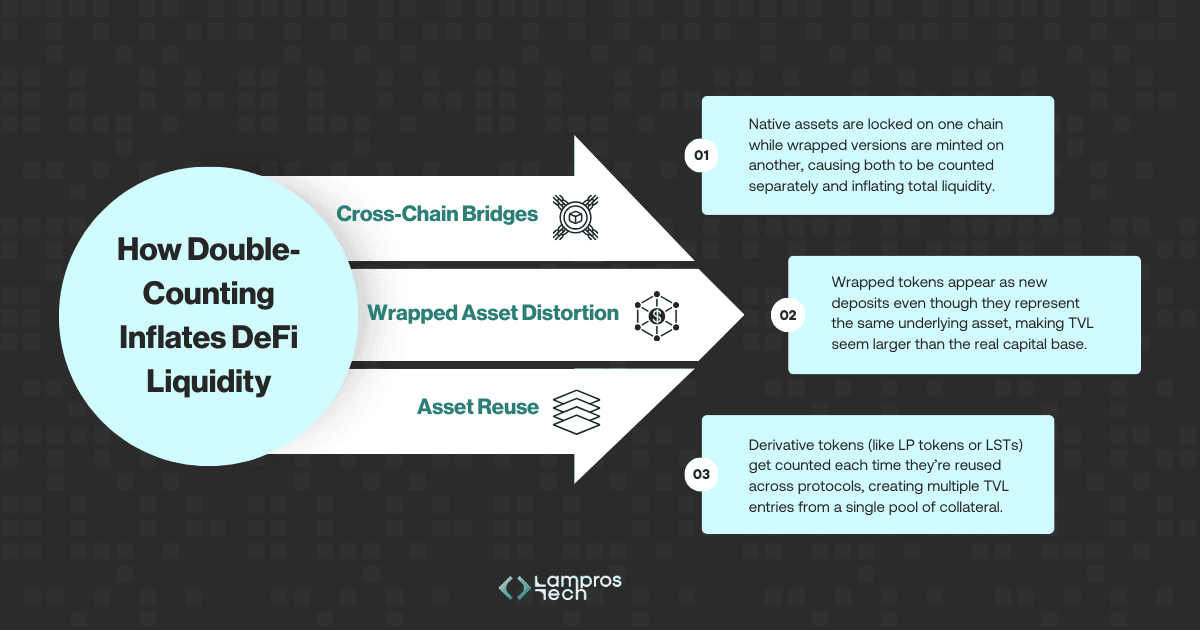
Multi-chain expansion has made cross-chain bridges fundamental to liquidity movement and interoperability. These bridges operate by:
While this mechanism enables capital mobility, it introduces a major flaw in TVL accounting.
Why does this happen:
For example, when $100 million in ETH is bridged to Polygon, dashboards record $100 million locked on Ethereum and another $100 million in wETH on Polygon.
This duplication creates the illusion of $200 million in liquidity, even though the underlying capital remains the same.
Additionally, wrapping and unwrapping transactions are often misread as new deposits or withdrawals, further inflating TVL and exposing a core issue.
And the same mechanisms enable interoperability to compromise its accounting accuracy.
DeFi’s composability allows protocols to interconnect, enabling users to move assets across lending, staking, and yield platforms.
While this design enhances capital efficiency, it also amplifies double-counting when the same collateral is reused across layers through derivative tokens like LP tokens or Liquid Staking Tokens (LSTs).
Why It Happens
For example, $50M of ETH staked in a DEX is counted once, then its LP token used as collateral in a lending protocol is counted again, and when those assets are restaked or bridged, the cycle repeats.
This reuse makes the same funds appear multiple times across dashboards, inflating metrics, increasing systemic risk, and creating false signals of growth.
Beyond double-counting, fragile data infrastructure further distorts multi-chain TVL accuracy.
Tracking TVL across hundreds of protocols and multiple blockchains is complex. Each protocol has its own contracts, data structures, and token standards.
To calculate total value locked, data aggregators use on-chain adapters and off-chain systems like The Graph or APIs to collect and index data.
While efficient, this setup often leads to fragile pipelines prone to delays, desyncs, and reporting errors across networks.
Here are the main factors behind this fragility.
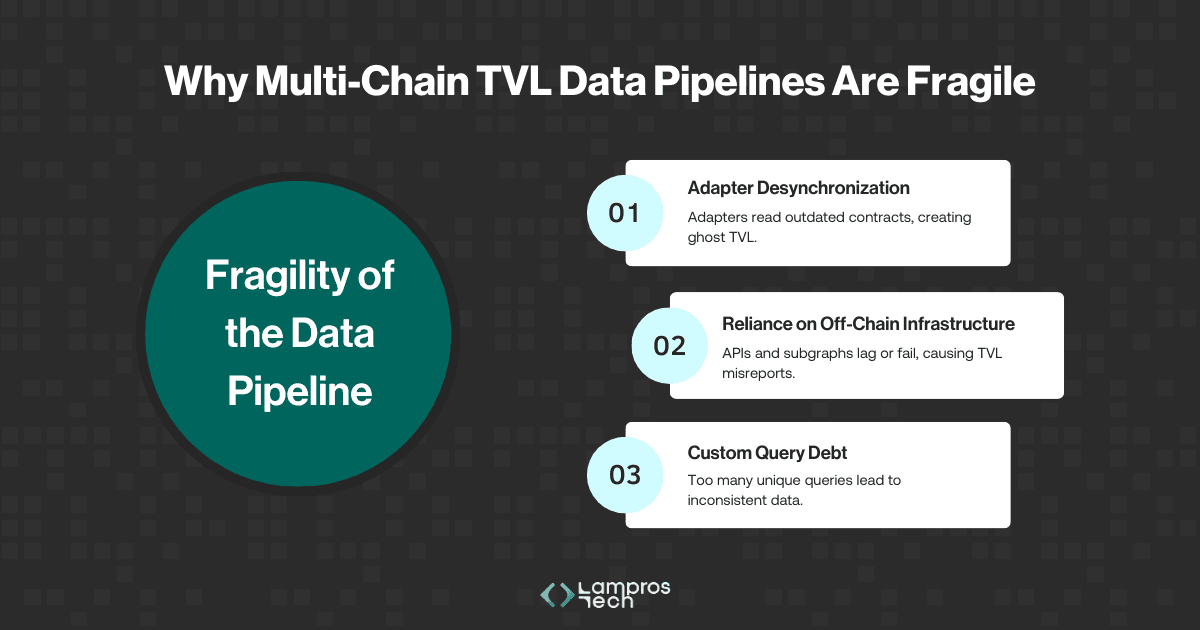
Adapters are responsible for reading balances and interpreting protocol-specific logic.
However, when a protocol upgrades contracts, launches new pools, or changes token behavior, its adapter must be updated immediately to stay accurate.
Why does this happen:
For example, when a lending protocol migrates to a new contract version but the adapter still references the old one, dashboards continue to display liquidity that no longer exists, creating ghost TVL.
This leads to misleading snapshots of protocol health and liquidity depth.
Aggregators depend on The Graph subgraphs and proprietary APIs to fetch, index, and price data efficiently.
While effective for scaling, these tools are centralised dependencies in a decentralised system.
Why does this happen:
For example, if an API endpoint used to fetch staking balances is rate-limited or fails to update during a network upgrade, the aggregator will show a sudden drop in TVL, even though no funds were moved.
These issues break the continuity of on-chain reporting and erode confidence in aggregated metrics.
Each DeFi protocol requires unique logic for reading data correctly, from how liquidity pools are structured to how wrapped tokens are priced.
Over time, hundreds of such custom queries accumulate across networks.
Why does this happen:
As DeFi scales, fragmented data queries create technical debt that’s hard to maintain, causing inconsistencies across dashboards.
Even small errors can ripple through the analytics stack. Achieving accurate TVL requires standardised adapters, less off-chain reliance, and on-chain validation.
Beyond data issues, incentive-driven liquidity further inflates TVL without reflecting real capital use.
Fixing TVL accuracy requires more than quick fixes; it needs structural reform across data standards, analytics pipelines, and ecosystem coordination.
The objective is not to measure more, but to measure correctly, verifying real liquidity, tracing capital origin, and separating genuine deposits from synthetic value.
Here are the key steps toward achieving verifiable TVL measurement.
The first step is establishing a shared framework for identifying and categorising assets.
This foundational layer ensures every TVL entry represents unique collateral, not a derivative claim.
Traditional TVL relies on off-chain data aggregation, which is prone to errors and manipulation.
The next evolution is verifiable TVL (vTVL), a method based entirely on transparent, on-chain data.
By grounding TVL in a verifiable on-chain state, ecosystems move from approximation to auditability.
Reliability starts at the pipeline level. Aggregators and protocols should collaborate to minimise synchronisation failures and technical debt.
This creates a resilient data layer that can evolve with the protocol landscape.
TVL alone no longer captures DeFi’s complexity. To measure real growth and capital efficiency, analytics platforms must combine TVL with qualitative metrics.
By tracking these in parallel, analysts can contextualise TVL rather than treating it as a standalone measure of health.
Accurate measurement requires shared accountability between protocols, data providers, and governance bodies.
Transparency turns TVL from a marketing metric into a verifiable public good, a shared infrastructure layer for reliable ecosystem data.
Standardised data, verifiable methodologies, and transparent reporting will turn TVL from a vanity indicator into a trustworthy measure of economic activity.
With these reforms, DeFi ecosystems can move beyond inflated numbers and toward a data foundation that accurately reflects real liquidity, authentic participation, and sustainable growth.
As DeFi expands across chains, Total Value Locked (TVL) is no longer a reliable measure of growth.
Double-counting, fragile data pipelines, and incentive-driven inflows have turned it into a distorted indicator that often misrepresents real liquidity.
The future of DeFi analytics lies in verifiable and standardised metrics such as Total Value Redeemable (TVR) and Verifiable TVL (vTVL), frameworks that separate real, native capital from synthetic activity and allow anyone to validate data directly on-chain.
At Lampros Tech, we help protocols build verifiable TVL systems that remain accurate across upgrades and multi-chain expansions.
Our experts ensure your visibility stays as reliable as your contracts from adapter sync to automated vTVL tracking.
Explore our Data Analytics solutions or book a call to make your metrics verifiable, transparent, and upgrade-proof.

The multi-chain TVL problem is the systemic inflation of Total Value Locked (TVL) across multiple blockchain networks. It is primarily caused by double-counting of the same underlying capital, where assets locked on a source chain and their wrapped or derivative versions (like wETH or LSTs) on a destination chain are counted as separate deposits.
Double-counting occurs through two main mechanisms: Cross-Chain Bridges (where the locked native asset and the newly minted wrapped asset are both counted) and Asset Reuse (where derivative tokens like LP tokens or LSTs are redeposited as collateral in a new protocol, causing the same funds to be counted multiple times).
Verifiable TVL (vTVL) is the next generation of DeFi liquidity measurement. Unlike traditional TVL which relies on fragile, off-chain data feeds, vTVL is computed directly using transparent, on-chain smart contract data and proof-of-liquidity models to ensure the reported value represents unique, non-derivative capital.
While TVL remains a key metric, it should be supplemented with alternatives like Total Value Redeemable (TVR), which excludes derivative assets; Protocol Revenue; Capital Retention Rate; and the Utilisation Ratio, which measures the share of TVL actively generating yield.
Inaccurate TVL can result from fragile data pipelines, including outdated or desynchronized protocol adapters that fail to correctly read current contract balances (creating "ghost TVL"), and over-reliance on centralized, off-chain API infrastructure that can experience downtime or reporting errors.
Web3 Data Expertise
Talk to our analytics experts and discover the power of your data.
Talk to our experts