
COO @ Quorivex Systems
We wanted to automate a few workflows but weren't sure where to start. Lampros helped us cut through the noise and get something useful into production quickly.

CTO @ Teralynx Systems
They picked up our processes surprisingly fast and built around how we already worked instead of forcing us into a new system.

Financial Technology Company
We saw value pretty quickly. A lot of repetitive work that used to take hours every week simply stopped being a problem. Our team could focus on higher-value work instead.
Contact Us
Ready to Ship AI Systems to
Let's align architecture, execution, and delivery from day one.
Published On Jun 17, 2025
Updated On Jul 14, 2025

Leaping into decentralized technology is not just a technical decision, it's a strategic one.
For many businesses, the first challenge is clarity. Do you even need blockchain? If yes, which type fits best - public or private? Ethereum or a sidechain? And how do you make it work smoothly with what you already have?
This decision-making maze often leads to wasted resources, overengineered systems, or technology that looks good on paper but adds little real-world value.
In this blog, we’ll explain blockchain types, when decentralized tech truly adds value, share real success stories, and offer a simple decision tree to guide your way.
Let’s dive in.
In our last blog - "Do Business Really Need Blockchain" we discussed how decentralized tech is changing industries for real.
Adopting it isn’t just a tech upgrade, it's a fundamental shift in how digital infrastructure functions.
But not all blockchains are the same. The model you pick shapes how efficient, secure, and future-ready your solution will be or if it’s just more complex.
The key is matching your business goals with the right blockchain’s strengths.
Let’s break down how each type works, when to use it, and what impact it can make.
A public blockchain is fully decentralized and open to everyone. Anyone can read data, validate transactions, and deploy apps.
It runs without central control, relying on consensus mechanisms across thousands of independent nodes like Ethereum’s Proof-of-Stake or Solana’s Proof-of-History.
These networks are transparent, tamper-proof, and accessible worldwide. Using a public blockchain cuts out intermediaries, boosts transparency, and supports open interaction which is perfect for global users or community-driven platforms.
When to Use:
Pros | Cons |
|---|---|
Trustless and censorship-resistant | Regulatory and compliance challenges |
Fully transparent and auditable | Limited privacy since data is public |
High security via distributed consensus | Not ideal for sensitive or internal business data |
A private blockchain is a permissioned network run by one organization or a select group. It controls who can access and validate transactions.
It uses internal consensus methods like RAFT or PBFT among approved nodes. They are not open to the public and are usually designed for high-performance, secure, and auditable internal operations.
It offers benefits like immutability, traceability, and automation without exposing data publicly.
They are especially useful for enterprises looking to improve process integrity, compliance, and coordination within a secure environment.
When to Use:
Pros | Cons |
|---|---|
High throughput and performance | Limited decentralization which requires trust in the operator |
Controlled privacy and access | Lower resilience due to central control |
Easier to comply with regulatory requirements | Interoperability challenges with public systems |
A consortium blockchain is a partially decentralized, permissioned network governed by a group of pre-approved organizations or individuals rather than a single entity. It offers shared control over the network while maintaining strong performance and access management.
Trusted parties operate validator nodes and manage consensus together. It’s like a private blockchain but built for collaboration.
Platforms like Hyperledger Besu, Corda, and Quorum facilitate collaborative governance, letting groups like banks or logistics firms share infrastructure without one party dominating.
When to Use:
Pros | Cons |
|---|---|
Shared control builds trust across parties | Requires coordination among stakeholders |
Better performance than public chains | Not fully open or permissionless |
Tailored governance structures | Setup and governance can be complex |
Choosing the right blockchain depends on your specific needs. Each type be it public, private, or consortium offers unique benefits and comes with its own trade-offs.
The real value lies in matching your business goals with the strengths of the right model to create solutions that are practical, scalable, and future-ready.
Now that we’ve covered the different blockchain types, let’s explore when decentralized technology is truly essential to adopt.
Decentralized technology is not a one-size-fits-all solution; rather, it addresses particular challenges related to trust, coordination, and security.
Understanding when to leverage decentralization can help businesses unlock meaningful value and avoid unnecessary complexity.
Here are the key scenarios where adopting decentralized tech truly makes a difference:
Decentralized infrastructure, enables trust among stakeholders without reliance on intermediaries.
In industries such as trade, finance, logistics, and cross-border payments traditional systems depend on clearinghouses and regulators which increases costs, introduces dependencies, and exposes the system to additional risks.
Blockchain establishes trust programmatically using public chains like Ethereum, which leverage proof-of-stake, cryptographic signatures, and smart contracts to automate and validate transactions without human intervention.
This approach delivers:
Open and auditable records are critical in industries like ESG reporting, government spending, and pharmaceutical traceability to ensure regulatory compliance and build consumer trust.
Blockchain delivers this through a transparent, append-only ledger that records every action with a timestamp and is accessible to authorized parties for inspection.
For instance, in food supply chains, blockchain tracks every step from farm to shelf, providing regulators and consumers with a tamper-proof record of a product’s journey.
This transparency offers:
When data accuracy, consistency, and permanence matter, decentralized tech delivers strong guarantees.
Unlike traditional databases where admins can edit or delete data, Blockchain ensures that once data is written and confirmed, it cannot be changed without consensus.
With cryptographic hashing and linked data, it creates tamper-proof logs that make unauthorized changes nearly impossible.
Key benefits include:
In open ecosystems like DAOs and open-source platforms, traditional centralized governance is replaced by community-driven decision-making.
Using smart contracts and tools like Snapshot, Tally and Agora stakeholders vote on upgrades, funding, and roadmaps.
This approach offers:
Projects like Uniswap showcase how on-chain governance manages protocol upgrades, treasury funds, and roadmaps, fostering trust and collaboration in decentralized systems.
In high-risk environments like digital asset management, critical infrastructure, or sensitive data handling, security is important.
A centralized system can be compromised if an admin account is hacked. Decentralized systems, however, distribute control using asymmetric cryptography and consensus among independent nodes, ensuring robust security.
By replicating data and logic, they remove single points of failure and keep running even if some nodes go down.
Public-key cryptography enables secure access control without centralized authentication thus reducing attack surfaces.
This approach excels in:
For example, Web3 wallets like MetaMask empower users to control their keys, minimizing risks and embodying the security-first ethos of decentralized systems.
Decentralized technology offers powerful solutions when trust, transparency, data integrity, governance, and security are paramount.
However, while decentralization brings significant benefits, but sometimes can’t be used in some scenarios as it may introduce complexity or inefficiency. Let’s see in what scenarios one can use centralized tech.
While decentralized technology offers many advantages, it’s not the right solution for every problem.
In some cases, traditional centralized systems provide greater efficiency, lower costs, and simpler implementation.
Understanding these limits helps you avoid unnecessary complexity and make smarter technology choices.
Here are some key scenarios where opting for conventional solutions makes more sense:
Decentralized networks, especially public blockchains, often trade speed for security and consensus. This makes them less suitable for applications requiring high-frequency transactions or real-time data processing.
For example, financial trading platforms or gaming environments that require sub-second response times may find block confirmations slow.
Even Layer 2 scaling solutions, while significantly faster than their base chains, still can’t match the millisecond-level latency of centralized systems.
If your application depends on instant execution or high-throughput data pipelines, decentralization may become a bottleneck rather than an advantage.
For small businesses, decentralized infrastructure can be expensive. The cost and complexity of running nodes, managing smart contracts, and securing private keys often outweigh the benefits in controlled environments.
In these cases, a secure and well-managed centralized system can deliver the same value with far less effort.
If trust boundaries are clearly defined and all operations occur within a single organization, decentralization doesn’t offer a significant upside.
Ultimately, choosing decentralization should be a deliberate architectural decision rather than a default. If your use case prioritizes speed, simplicity, or full control, traditional centralized systems will likely serve you better.
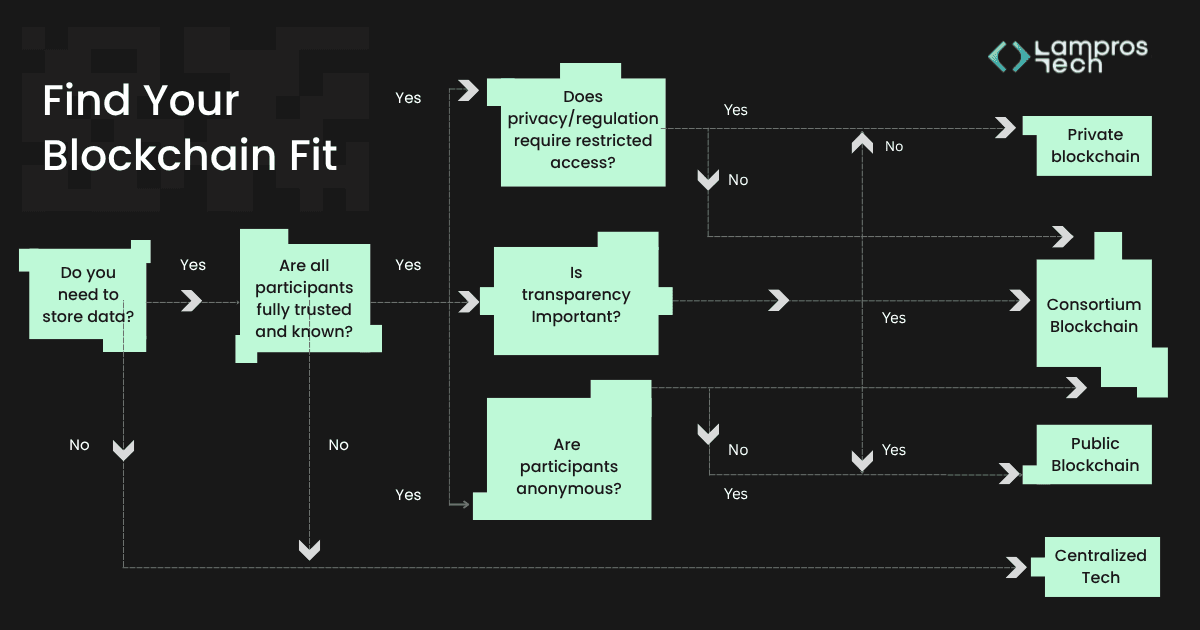
For a clearer understanding of when to use each blockchain type, we’ve created a decision tree.
To simplify your blockchain choice, here’s a decision tree that guides you through key questions to find the best fit for your business needs.
Let’s look at how different companies have adopted decentralised technologies and have succeeded in it.
Here are some use cases where various companies have successfully integrated decentralized technologies to solve real challenges and create lasting value.
These examples highlight the practical impact and strategic benefits of thoughtful blockchain adoption.
UPS partnered with Inxeption, a blockchain-powered industrial commerce platform, to improve how B2B sellers manage complex logistics and sensitive order data within their existing supply chains.
Why it succeeded:
OriginTrail a blockchain supply chain tracking is built to secure supply chain data across multiple sources and standards.
It allows manufacturers, auditors, logistics providers, and regulators to publish and verify product-related data certifications, handling and origin across a shared blockchain layer.
Why it succeeded:
Decentralized technology holds transformative potential, but only when applied with intent and clarity. It’s not just about adopting blockchain because it’s trending; it’s about solving real business problems that demand trust, transparency, data integrity, and secure coordination across stakeholders.
But knowing when, why, and how to adopt decentralized technology is the real challenge. Choosing the wrong model or integrating it without a strategy often leads to wasted time, inflated costs, and little meaningful impact.

You need blockchain if your operations involve multiple parties, require high trust, or need tamper-proof data. If you're solving transparency or coordination problems, it's worth exploring.
Public blockchains are open to all, private blockchains are controlled by one organization, and consortium blockchains are shared among a few trusted entities. Each fits different use cases.
UPS used blockchain for logistics transparency, while OriginTrail enables secure supply chain tracking. Both show how blockchain improves coordination and data integrity without replacing legacy systems.
Blockchain creates tamper-proof, timestamped records that boost trust and auditability. It ensures data consistency across systems and is perfect for regulated industries and traceability use cases.
Decentralization reduces single points of failure, strengthens security, and empowers stakeholder-driven governance. It supports scalable, future-ready systems for businesses aiming to stay ahead.
Stuck on blockchain trade-offs?
We’ll help you decide what fits your architecture and what doesn’t.
Talk to our experts