Blockchain Interoperability
Modernizing Educational Certificate Issuance with Blockchain Infrastructure
Need for Secure & Verifiable Credentials in Education
Educational institutions today face three critical issues:

Certificate fraud

Slow verification workflows

Increasing regulatory scrutiny around personal data.
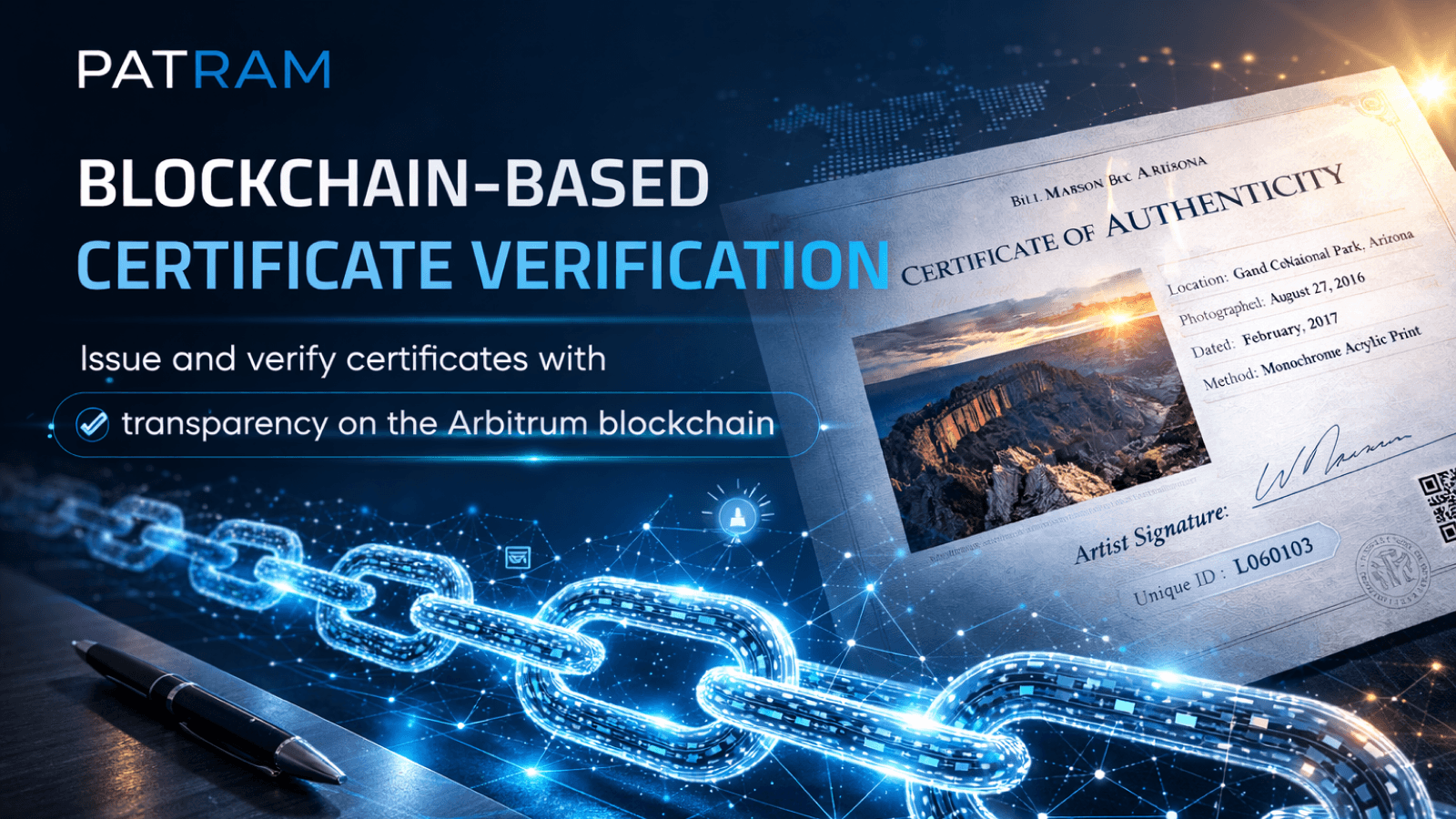
To address this, we built Patram, a blockchain-powered verifiable credential platform that gives every certificate a permanent, tamper-proof digital identity.
The result is not just digital certificates, but secure, verifiable infrastructure designed for institutional scale and regulatory confidence.
Overcoming Blockchain Security & Compliance Challenges
Regulatory Compliance Without Compromising Usability
The platform had to comply with DPDP while securely handling personal information, without breaking previously issued certificates or disrupting institutional workflows.
To address this, we implemented:

Encrypted sensitive data at the field-level AES-256-GCMAn industry-grade encryption standard used to securely protect sensitive data from unauthorized access. encryption

Enabled selective access to required data fields

Maintained full compatibility with legacy certificates
This ensured privacy-by-design architecture aligned with regulatory expectations.
Reducing Data Liability & Storage Risk
Storing certificate PDFs permanently increases security risk, compliance exposure, and infrastructure overhead.
To address this, we:

Eliminated permanent PDF storage

Enabled secure, on-demand certificate generation

Stored only verifiable credential data and cryptographic proof
This approach drastically reduced data footprint and lower long-term liability.
Ensuring Performance at Institutional Scale
Administrative dashboards experienced slowdowns due to inefficient database queries, impacting operational efficiency.
We Implemented:
Optimized database queries for faster data retrieval
Structured record visibility for predictable system load
Improved query performance without increasing infrastructure complexity
The system became stable and scalable under institutional usage.
Balancing Security with Operational Efficiency
Manual wallet authorization created delays while strict governance controls needed to be preserved.
We solved this by:
Implementing structured role-based access control
Enabling automatic authorization for designated administrators
Adding secure validation for unauthorized attempts
This improved usability while maintaining strict role-based control.
Architecture & Engineering Approach
We followed a structured, security-first engineering approach to design and deploy the platform. We started with -

Structured Development Lifecycle
We built a clear end-to-end credential flow, ensuring every certificate receives a permanent, verifiable digital proof designed to scale.

Institutional-Grade Access Control
A structured role-based system enables secure delegation while preserving governance and accountability.

Standards-Driven Infrastructure
Built on globally recognized credential and decentralized identity standards to ensure interoperability, auditability, and long-term compatibility.

Built-In Security & Compliance
Security was embedded from day one through strong encryption, data minimization, smart contract testing, continuous monitoring, and DPDP alignment.
KEY OUTCOMES
Zero Tampering Risk
Blockchain-anchored credentials that can be independently verified.
Regulation-Ready Infrastructure
DPDP-aligned privacy architecture with encrypted personal data.
Reduced Data Liability
No persistent PDF storage and strict data minimization.
Improved Operational Efficiency
Optimized dashboard performance and cost-efficient blockchain batching.
Scalable Institutional Governance
Structured access control built for universities and certification bodies.
The platform is now capable of supporting universities, certification bodies, and edtech providers at scale, while maintaining compliance, security, and user experience.
Engineered for Real-World
The platform establishes a secure, regulation-ready credential infrastructure built to support institutional governance, operational efficiency, and sustainable scale.
It enables educational institutions to move beyond manual verification and fragmented systems toward a unified, verifiable framework designed for long-term compliance, trust, and growth.
Technologies Used